Wednesday, April 9, 2014

Golf's Holy Week: The Metaphor of the Masters

Golf's Holy Week: The Metaphor of the Masters
In a sports-saturated culture like the U.S., people compare themselves to the games they like to play. Reading the newspaper, magazines, television, even sermons use sports to illustrate their points of view. Businessmen refer to moving their players around the chessboard of the market; using the “team” analogy in almost every presentation about their groups.

The Masters®
Bobby Jones (co-founder) on the course

If there is a “holy week” in golf’s religious calendar this is the week. We’ve hosted the PGA Tour® in Houston and all of golf’s attention now focuses on Augusta, Georgia and the Masters® which is the first and most prestigious major tournament; a tradition unlike any other. Most golf fans consider this the official start of golf season, like NASCAR®’s Daytona 500; and they worship Augusta as some sort of mythical Shangri-La location, like mecca to where all golfers hope to ascend. My two favorite Masters tournaments were 1984 and 1995 both won by Texas Longhorn Ben Crenshaw in dramatic fashion; yet first time winners Larry Mize (1987) and Phil Mickelson (2004) were the most remarkable and rewarding for the players as professionals.  

I’ve previously written a blog post about golf (August 2011):  http://bit.ly/1qdrHkV


I look forward to watching the Masters® broadcast over the weekend, in part because it includes so few commercials. Even though they appear on the same network, seemingly every game-break during MarchMadness® necessitated another loud advertisement. Everything about the Masters® telecast radiates the soft pastel beauty of an azalea spring; even the music, narration, and camera angles. (Full disclosure: this is the first time I’ll watch it in full-HDTV!)

From the concessions (burger, chips, and a beer for $6.50), to the bathrooms (all have attendants), to the pro shop (ship directly from UPS next-door), and the immaculate condition of the grounds (no cart paths), the event exudes pure southern class more than any commercial sporting venue. Many consider this tournament the highest priority for viewing in the entire year of sports; more important than the SuperBowl®--put simply, because of its “old school” charm.
Like chess, with its distinctive board, players, and strategic moves; golf involves fighting against an opponent in an intensely mental competition. I propose that golf provides an excellent canvass on which to paint the metaphor of life; but it is difficult game to embrace.
As a family man, golf extracts a certain amount of guilt as a result of dedicating half a day to the game. It’s inconvenient, expensive, and elitist. By elitist I don’t mean snobby, but the fellowship of golfers is not broad like sports we all play as youngsters. Like scotch, one develops a taste for golf later in life; however it is a “human” game with great historical significance.

Although many complain about its archaic and cumbersome format and rules, the handicap system gives an egalitarian opportunity for any player to challenge any fellow golfer to a match. Each golfer is equally weighted against the other based on the difficulty of the individual holes and how many shots the weaker player is given. It’s pretty cool.
After a long time apart, I re-acquainted myself with golf last October on a beautiful Sunday when all conditions were right for a game. KHOU-TV ran a story about the old Gus Wortham Park falling into disrepair and the city’s intent to re-organize the golf course or even demolish it. My family was out of town and the weather was perfect. The story provided me with the opportunity to learn some local history and get some casual exercise as well.

The city bought this course from the old HCC in 1972, and I curiously drove far into east Houston to find this historic site, originally designed in 1908. I suspected that it would be a classic styled shorter course, with cousins in Fort Worth, Austin, Oak Cliff, and Hermann Park. Besides, wasting another Sunday on the Texans or Cowboys did not seem like the best use of my time. The day provided a serene atmosphere and an enjoyable round; nature’s beauty combined with man’s ingenuity. The quiet solitude, the fall breeze, the beautiful pastoral setting; all combined for a therapeutic session of reflection and escape.
I decided to re-approach golf with lowered expectations. My game is weaker with no practice and ancient equipment, my attitude was simple: it’s a nice day, just go play! I lean toward hitting range balls for stress relief, my performance never exceeds inconsistency, flashes of brilliance, or the perfectionism bred by watching too much televised professional golf. My conscious goal was to learn the course by studying its terrain, grass, and greens; as well as walk the course in the pure golf tradition, taking care not to compare myself to any other golfer on this beautiful day. Secretly, I wanted to see the amber sunset over the last green as I finished the round, but I wasn’t sure I could finish all 18-holes that evening. Other than that, I held no agenda for this fresh round of golf.

One can learn about golf at an early age in “Junior Golf;” it’s like Sunday school—basic and easy to consume, but fundamental to proper mechanics. Even so, golf and life get more complicated when you get out onto the course and each shot presents risks & rewards, challenges & hazards. Learning the game early in life doesn’t guarantee future success, but like the scriptures admonish, raise a child right and when they grow up they will not depart from the Lord’s ways.

I resisted the innate urge to focus on completing tasks successfully. After a life of competition, the meticulous score-keeping of golf would naturally attract me, right? Yet, it isn’t a perfectionist’s game—they left the course long ago. Golf in all its complexity and seriousness is a game of grace. Like life, for those of us in the big, competent, average middle, golf reflects the ceaseless requirement of circumstances in life requiring mercy, patience, and forgiveness. 


Simple elegance or refinement of movement describes the subtle “grace” of a golf swing. I mean grace as a temporary exemption, a reprieve from the harsh criticism deserved for plunking a ball right in the water hazard. Grace in golf holds the hope that the next shot will be better, and finishing the round successfully generates smiles and the peace of mind enjoyed from simply playing the wonderful game on a pretty day. Grace is good for us, so golf is good for us. I keep trying this difficult game both for the good of the game and for the good of me!
 

Golf is like life in that every day is like every hole or every shot; it must be embraced one step at a time, and we cannot lose focus of our own vision, focus, or swing. Without concentration and balance, along with rhythm and confidence, I tend to rear back and hack at the ball with questionable results. The beauty of golf’s structure is that even after the worst hole, the score is written on the card and you proceed to the next hole. All the previous good or bad is forgiven and forgotten. [Jack Nicklaus, after making a quadruple-bogey 7 at the 12th hole of Augusta in 1991 and then making four consecutive birdies, said: "You have to put such things out of your mind."]

Each shot requires individual consideration and execution just like every day of our lives. The past is gone, the future uncertain; all that exists is the shot before you right now. Alistair Cooke said, “Golf is an open exhibition of overweening ambition, courage deflated by stupidity, skill scoured by a whiff of arrogance.” I’ve always remembered the great courses and the good shots, even years later.
“What makes the Masters different from the other 3 majors? Every shot was a summation of every shot played in my whole career. As fans, or as an announcer, one senses that. We very rarely see quick, careless swings at the Masters. Poor shots, yes, but never lax ones. Only the Masters brings that out.”  --Nick Faldo as told to Jim Nantz
Each hour is a swirling storm of thoughts, feelings, desires, etc.  Some are good, some are bad, like golf rounds with sweet shots and balls in the water hazard.  The rules of golf established by the Royal and Ancient Golf Club at St. Andrews Scotland are similar to God’s established moral standards, telling us which actions are good and which are bad.  Romans 7 says we should resist the bad impulses and cultivate the good.  A person's feelings vary hour-by-hour, just as my mood changes every shot and every hole on the golf course; yet they don’t change the standards of the game, even when I desperately want them to.
Character in life and golf is doing what is right when no one is watching; golf’s intense culture of self-regulation, and long held gentlemanly standards reflect daily life as much as any game I’ve played. The final day of The Masters® Tournament provides heightened drama: golfers' caddies traversing the back-nine like sherpas, competitors matching birdie for birdie with shot after shot. The greens of Amen Corner, with undulations and tricky pin placements call out for shots like the "Sirens," living on three small, rocky islands enticing golfers, but ultimately causing them to crash their ships into them, sinking their hopes for winning. ##
Scattershooting:
Dan Jenkins, covering the Masters® for his 63rd year:

"I can only tell you that eggs, country ham, biscuits, a pot of coffee, a morning paper, a table by the window overlooking the veranda and putting green, listening to the idle chitchat of competitors, authors, wits and philosophers; hasn't exactly been a torturous way to begin each day at the Masters all these years." (end quote)


The Masters®

[2014 Tournament Facts:
  • This is the 78th Masters Tournament
  • 97 players were invited to play this year (six are amateurs)
  • 25% of the players have never played this tournament before
  • The favorite to win, Tiger Woods will miss the tournament this year for the first time since he was an amateur...
  • Defending champ: First-time winner Adam "Ozzie" Scott (only 3 winners repeated)
  • It is the only major where a winner hasn't shot in the 60s for all four (4) rounds in victory
  • Coverage Thursday and Friday on ESPN
  • Coverage of the final two rounds is on CBS
  • Wall-to-wall coverage on Westwood One and SiriusXM satellite radio]

©Mark H. Pillsbury

Sunday, March 23, 2014

Taking Potshots at Potholes

Taking Potshots at Potholes:
Public Stewardship & Public Enemy #1
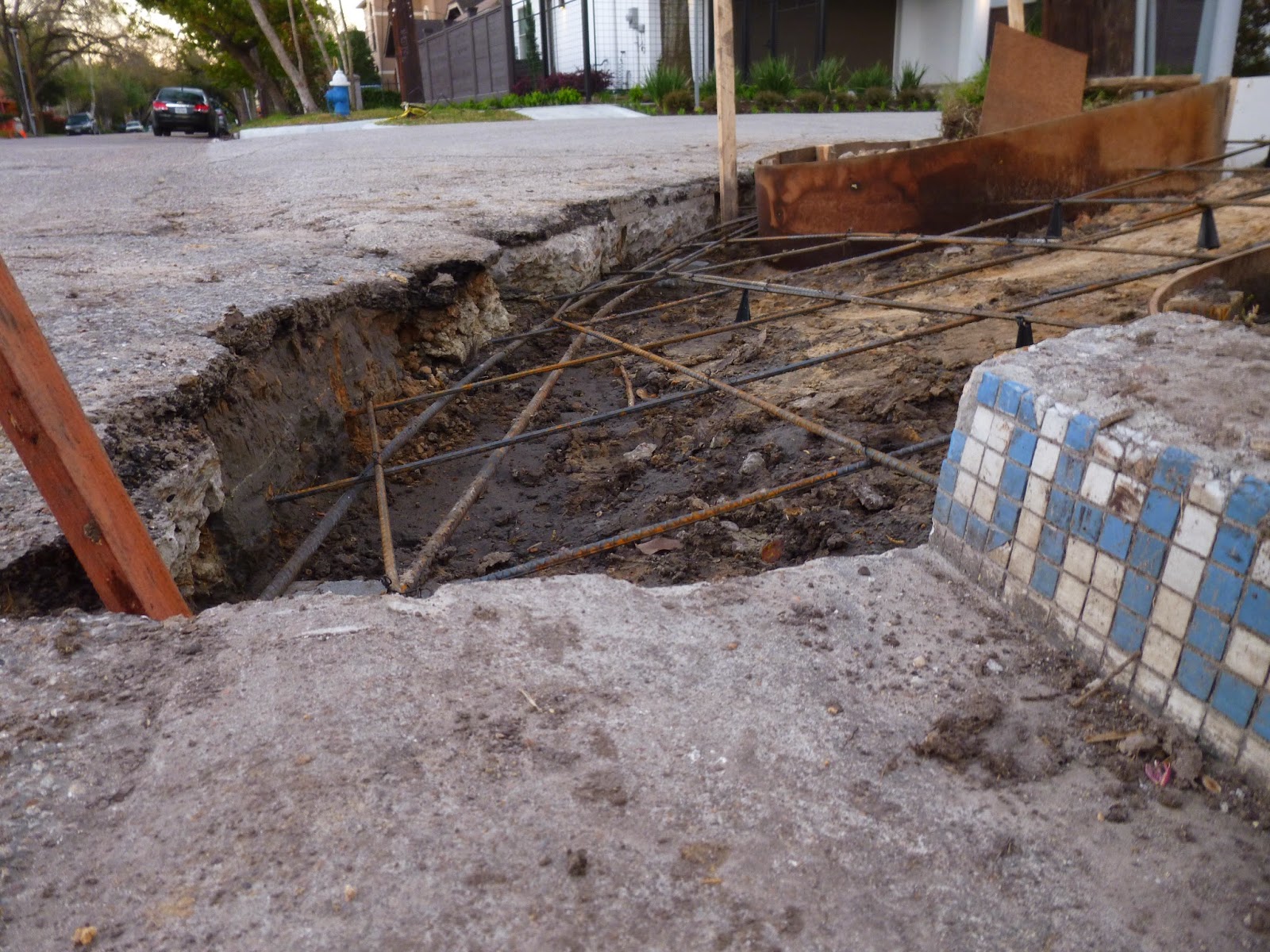
An immediate gratification, “rock-star” culture says, “you can have it all;” so why can’t the City of Houston have sexy parks, bridges, trails, foliage, bayou views, separate paths for bikers and runners; as well as smooth streets without potholes?
 

Citizen drivers weave around on decaying streets, further burdening them as they try to live their stressful lives. A smooth ride is interrupted by a sudden jolt, unexpected and jarring. Pressure builds, heightened by the inconvenience and pain of traffic in Houston: too many people going in the same direction at the same time. I believe that minimally, our government owes us good roads, just as it says it owes its citizens equal justice under law. Don't you agree?
As my car’s under-carriage rattles over concrete crevasses, dodging massive cracks in our pavement the size of the San Andreas Fault; there’s no avoiding the havoc wreaked by this civic catastrophe. If you’ve ever survived the gauntlet of Houston’s potholes in almost any neighborhood, look at the vehicle in front of you as the road tries to eat it alive; most of our automobiles weren’t made for this kind of abuse. Watch the violent shaking and jostling  of the car’s suspension in front of you; if you see natural mechanical reactions then let me know: it looks horrible to me.
Blogging about this problem is my humble attempt to echo satirist Paddy Chayefsky’s famous line spoken by the outrageous Howard Beale in Network (1976). Don't view my effort as caricature; indeed, my hopes are that at least one local elected official, even the Honorable Mayor, would read this and know that there are thousands of honest, taxpaying citizens of this city that are thinking the same irate thoughts but don’t have the time, voice, or platform to yell out from their car windows:
"I'm as mad as hell, and I'm not going to take this anymore!"
(MGM, 1976)
Buffalo Bayou Park stretches over 10 miles from Shepherd to the central business district with a wide variety of public recreational areas on both sides of the bayou. Multiple years and millions have produced a gem for all Houstonians. I’m not anti-park or anti-public recreation; this new area along the bayou is Houston’s answer to Central Park. Having exercised in this area, it's clear it is a wonderful addition to our public life; however, I also drive hundreds of miles all over Houston’s lousy streets, bouncing from one canyon to another in the regular roadways of our city. To which person do we cater? The commuter or the tri-athlete; the delivery truck or the strolling mommy? If the solution is not unlimited taxation; civic priorities must constantly be weighed like a personal budget: wants versus needs?
 
Buffalo Bayou Park Under Construction
I’m not complaining that there are as many construction cranes and concrete trucks barreling along Houston’s roads as any city in the country. There is inconvenience in “progress;” just as the drought and roots of our massive live oaks buckle the ground underneath the road beds.
 

This blog-post is heavy on advocacy and light on blame; potholes surpassed mosquitoes as public enemy #1 in the bayou city—the solution is not complicated: spray for pests and patch the holes in every neighborhood. If NASA can put spaceships into orbit, our elected representatives can fix the plague of potholes. One district, one street at a time!
 
This chastisement of public stewardship finds root in the recent wasting of city funds on non-performing investments like red-light cameras (Civil settlement, $12MM), or Astrodome maintenance ($1MM/annually). One repaired hole costs $20, so I'd trade a dark Astrodome for 50,000 less potholes, wouldn't you? And this pothole-burden isn’t an isolated situation; there are other city's municipal budgets shrouded in debt, or floundering in mismanagement whose streets engulf drivers too. On the other hand, this city is booming; there’s no reason all our gasoline taxes can’t fix the crumbling roads. It's a management problem Houston; but where is the political will to fix it? Is anyone listening?
 
(Ever heard the joke; Q: How many City of Houston workers does it take to fill a pothole? A: 9!)
 
Government at the local level is about as basic as it gets in politics! This isn’t about Super-PACs, Hilary Rodham-Clinton, or Meet the Press. CNBC’s Rev. Al Sharpton won’t stoop so low as to talk about potholes, because they don’t involve race. Nevertheless, this political message carries immediate impact: the same way my car shakes with a boom; unexpectedly careening over a gaping chasm of concrete. If Houston is a first-class, global city; it should act like it.
Mayors famously lose their elected offices for not clearing snow or rescuing stranded citizens in a hurricane? The key component of a city government is their Budget: it’s the city’s business plan. Whether to spend important budget dollars on one project over another (especially when they're both good) provides circumstances in city government critical to quality of life in the town. Even in a city as large as Houston, tough choices can cost elected officials their jobs. Now is this sort of time. I’m urging our city government to drive around the streets and realize the embarrassing condition of the roads: pocked and pitted, gaping gashes, ribbons running like giant fissures; streets grey and cratered like the Moon's surface. While running along our largest bayou is a newly constructed, pristine fitness path:
Trail under the Waugh Bridge
Unlike Howard Beale, I’m not trying to get you to do anything. No class-action lawsuit, no riots, don’t call your favorite talk show on AM Radio, don’t even write your Congressman. I wouldn’t know what to say to a Congressman anyway. They answer your letters with canned forms, computer-generated rhetoric, anyway?! If you feel led; communicate however you feel comfortable. If you hear me, forward someone a link to my blog. I’m speaking for you right now by saying, "I'm mad as hell about these terrible Houston roads ruining my nice car!” 
Scenes from the Pothole Playhouse: 
(Screaming)
(Citizen): “I'm not going to take this horse-pookey anymore; our city has enough money to fix the potholes; if it would just use the political capital to do so;” he adds, "I'll be the chairman of the Pothole Task Force."


(Pointing accusingly)
(Second citizen): “For once, do something practical with our money; not just what gets the fancy attention, like a pretty new Park!” “Jeez, dude. Do your job, or let someone else try…” "It's not that darn complicated."
 
 Op-ed©2014—Mark H. Pillsbury (Houston, Texas)

Follow more on Twitter® (@markpills) 

[Serious Legal Disclaimer:  thoughts expressed here are my own, and do not represent the political opinions of any group, organization, or corporation with which I associate. The first amendment and the rules of the blogosphere protect all the free speech exercised herein. This doesn't represent a political cause or party, nor does it endorse a particular candidate. If an elected official feels offense or shame over the subject matter of this post, their response is out of my control, and they need to take a long look in the mirror.]

All pictures are ©2014—Mark H. Pillsbury (Houston, Texas) #nofilter
 
-30-


Sunday, February 23, 2014

These Old Boots

These Old Boots:
A Personification of Life and Literature

“Antique,” “vintage,” or “retro,” typically describes older furniture, cars, or equipment; but between the learning years of college and midlife, my “old” Red Wing® boots became personal relics—walking me through life. Since 1983, in Austin, Texas, they’ve watched three very active decades fly by; taking a lot of abuse along the way.

These boots cut down Cedar trees in the Hill Country and climbed the steps of higher learning at UT’s Old Main. Leo Schuster had a pair once, just like these. These tough old partners trudged to courthouses and jails all over North Texas, and they’ve had all sorts of spirits spilled on them at Greenville Avenue, or near the Crescent, in Dallas, on McKinney. Robert "Gig'em" Doggett polished them up one time after he lost a bet on the UT/A&M game. These trail blazers searched the creek bottoms of the Trinity River with the best DA investigator I’ve ever seen, George Espinosa; and they’ve helped Bill Bratton defend a murder trial in Ellis County. Red Wing® boots supposedly never wear out; although they have been torn, scuffed, and bruised along this life's journey.
(in their younger days)

I'm thinking of my boots in a literary context: like some of the popular “Male Detective/Protagonists,” tromping through recent paperback mystery thrillers. They are strong, but weathered, strident yet, they’ve slipped a few times. In this way they are like Michael Connelly’s Harry Bosch. These boots are 100% American made in the early '80s. They hold justice dear, and have walked through the fire of conflict with a fierce determination to stay on the right path, even when bullets whizzed-by, too close. In this way they are like Stephen Hunter’s Bobby Lee Swagger.
 
They’ve been the shoes of a caring family man, walking through good & bad decisions, unexpected change, moving & uprooting, including the deeply troubled pursuit of truth in all of life’s mysteries. In this way they carry the same hidden nobility as Henning Mankell’s Inspector Wallander. Being over 30 years old, they’re boots of a time traveler like Stephen King’s Jake Epping in 11/22/63; a guy who believed Catcher in the Rye should be in school libraries in 1962, and was brave enough to try to stop Lee Harvey Oswald. John Grisham’s Jake Brigance practiced law in Ford County, Mississippi, an hour south of Memphis; surely, he has a pair of Red Wings®. Wyoming game warden Joe Pickett, the character of C.J. Box, can destroy one pickup after another, but not his boots; they're forever.
Most of all they are Jack Reacher’s boots; walking quietly in the shadows, performing like him with strength and integrity, even when it would be easier just to walk away from a powerful but evil opponent. Quintessentially American, bigger than everyone else but slow to use his insurmountable power; Reacher saddles up as a one-man posse, a lone wolf drawing a hard-line against injustice of any kind.
 Like Reacher, these boots have been cut, stitched back up, rubbed raw and bloody; persistently standing against all odds. They are rugged, and comfortable carrying the load; ready and able to help wrongdoers reap what they sow. Jack Reacher isn’t as "flawed" as the protagonists mentioned above, maybe that's his appeal. Author Lee Child’s 18 Reacher novels consistently show readers a suspenseful story line with an ending as reliable as the hero: his opponents first ignore him, then they mock his lonely walk through life, often laughing at Reacher as they prepare to fight him greatly outnumbered; finally, they fall victim to his fierce prowess as a lonely warrior. Jack Reacher always kicks-ass. 
Photo from Flickr: ©Kati Giblin (for personal use in this post, I call it "Reacher's Shadow")
These Red Wings® traversed Washington and Fort Bend County with Barrett Davis, and they’ve scaled the bleachers of Texas Stadium with Brent Pogue at Leon Lett's ice bowl/fumble game of 1993. They saw the final SWC game at Kyle Field with Rob Holmes; and I’ve worn them with shorts while dove hunting near Brady, Texas, with John Hamlin. On a balmy morning in 2013, they carefully stepped around some gooey, abandoned retention "pits" in Galveston County. These boots love RodeoHouston® every year; they go perfectly with my rancher granddaddy Hampton’s felt Resistol® (pictured below w/ his great-grandson). In the harsh winter of 2014, they took over 21,200 steps through midtown Manhattan, jumping around puddles of gray, slushy snow, with real estate broker Alex Leopold. They go where they need to go and do what needs to be done, just like the boot and safety apparel company founded in 1905, in Minnesota.


The boots' layers of wax peel back like pages of my life story; it's best they can't talk. Looking worn out, much like their grateful owner; slipping them on is like catching-up with an old friend: mindful as you fall back into lock-step, commiserating on the past, hopeful about the future. When I think about being a faithful friend, father, brother, son, partner, employee, lawyer; whatever I'm tasked with on the day I pull-on these Red Wings® I try to focus on what is true, honorable, pure, lovely, just, commendable, strong, caring, and excellent—and just like these old boots, I start walking in the right direction...
©Mark H. Pillsbury
(3 of the pictures herein are shown by the “fair use” doctrine of using copyrighted material, not an infringement of copyright, but fair use according to 17 USC § 107)
##

Saturday, January 25, 2014

"Danger Zone" (Part 5 of the Top Gun Series) Fiction Ripped from the Headlines...

Danger Zone (Part 5)

 
Danger Zone video feat. Kenny Loggins (1986): http://bit.ly/19PHR0j
 
(Note:  all characters appearing in this work are fictitious. Any resemblance to real persons, living or dead is purely coincidental. The author’s fictional stories expressed in this blog do not reflect in any way those of the institutions to which he is affiliated, the Department of Defense, or the United States Armed Forces. Best efforts were made to portray the situations accurately).
 
Planes lined up under the flight deck, stacked vertically like a Manhattan parking garage. Humid Gulf air creeped into every tight crevice of the USS John C. Stennis (CVN-74), making surfaces warm and moist. Languid seas accompanied the mighty warship as it slowly cut through the dark waters of the Strait of Hormuz.
“We’re all going up tonight,” drawled the tall Texan Lt. Harrington, walking among the calibrated activity which dominated the flight deck. “This is exciting… I’m jacked-up!” He yelled in a distinctive twang. Pumped-up and walking with a swagger, he was a cross between Lt. Starbuck of Battlestar Galactica, and Tim Riggins of Friday Night Lights; totally at ease with himself, poised, not fighting against tonight's tension. Harrington seemed to float along with the electrified force field of bravado sizzling through the chamber tonight; the preparation and tension introduced the pilots to the arena, known as the “Danger Zone.”


Present were mammoth miracles of aviation called FA18-Super Hornets, sold to the Navy by Boeing, and housed by the aircraft carrier Stennis; ready at any time directed by the DOD or the POTUS, to hurl out into the sky as a pointed sword of American diplomatic, or military strength. “Code Yellow” represented the red hot power of these fully armed flying machines, poised to press hard into the dry Iranian desert like a searing branding iron. The yellow “Ops” folder possibly included full enemy engagement, and afterward the elimination of the nuclear production facilities of a terrorist state. It was gameday.
Steamy subway smells mixed with grease and the pungent odor of jet fuel as the orderlies filled the Hornets with 14,000 Lbs. of fuel, as well as five, 480-gallon exterior tanks. There was no smoking allowed anywhere near the flight deck; and the managers, clad in blue-coveralls, kept an eye on the fueling like a jittery lioness watching her cubs. “Stack ‘em and pack ‘em, Raaaallllph!” Lt. Harrington always elongatated the elevator operator’s name, like he did with his drinking buddies at Annapolis; stretching the name and wretching like a drunken sailor. He tried to keep things loose and light.

However, there were sensitive pilots, usually the newer ones to carrier flight, sitting in the flight room below, more dazed than focused; unable to loosen up while waiting to be called to the deck to climb into their Hornets. “I feel a little queasy Lieutenant,” said one of his junior officers, “but it’s amazing that you gave us the Code Yellow tonight; I’m ready for action!” Lt. Harrington saw those in line who looked conspicuously anxious, and he talked to each pilot who needed a small measure of re-assurance.

“Jack, you’re going to do fine; just stay with your wingman and if there’s trouble, listen to me on the radio,” Lt. Harrington knew that some of the squadron only recently passed the initial CQ (carrier qualification); but like his hero in coaching, John Wooden, he encouraged his team to concentrate on the important details, because it was the details that flew the airplane. He lived Wooden's Pyramid of Success: respecting the pressure of aerial combat but not fearing the enemy, being confident--not cocky, possessing an ease which came from knowing that his Stennis flyboys were prepared, and they would do their duty.

More from Lt. Harrington: Part IV:  http://rostranovum.blogspot.com/2012/06/thunderstruck-carrier-fiction-part-iv.html

To be CQ the pilot made 12 day landings and 8 night landings, with a minimum of 6 arrested stops done according to standard procedure by catching the right wire. War is meant for young soldiers, and air battles are best maneuvered by young pilots, with amazing physical requirements as well as the mental tests provided by these complex airplanes. The modern Navy's details, demands, and decisions flowed toward the pilot at an increasing rate as the engagement reaches farther into the flight plan.
Lt. Harrington earlier informed his squadron that they would be circling down from a high orbit around the Persian Gulf; locking in on two sites probably containing the full-fledged nuclear weapons program of The Islamic Republic of Iran, previously said to be dismantled by the Iranian government. If the fighters from the Stennis happen to encounter the Iranian Air Force (IRIAF), concurrent instructions were to meet any force with equal firepower. Lt. Harrington's small yellow folder, paraded to his team earlier in the evening, carried with it the assembled might of one of the most powerful war-making machines ever invented; used specifically to dismantle a persistent threat to middle-eastern peace and the secure valuable shipping channels in the Strait of Hormuz.
Choreographed like ballet, launch operations this evening featured a fighter/bomber with a combat range of 390 nautical miles, inserted into a war theater in minutes, flying vertically at 228 meters per second. One by one, the handlers launched planes built to climb 45,000 feet in one minute, quickly creating pre-planned groups high above the danger zone. Upward acceleration is felt as weight, otherwise known as g-force. The Hornet can withstand a mind-boggling load factor of 7g’s. Proper g-forces during ascent or the plane’s frequent power turns affect the pilot’s vision and breathing as gravity pushes down one times his weight per “g.” Pilots survive time in the seat during peak g-force only through vigorous training and preventative practices which augment the special flight suit. The upward force applied as the catapult violently throws the plane off of the deck, combined with the powerful climb rate, tend to take the blood away from the pilot’s head; otherwise known as “the deep sleep,” in reference to where a pilot ends up at the bottom of the ocean, after blacking out.


After the initial shock of takeoff, they formed into a coordinated approach to the target; each Hornet carrying six-barreled rotary cannons that fired 20mm bullets, as well as a variety of missiles, bombs, rockets, and other guided weapons. The plane is even equipped with an elaborate air-launched decoy system for defensive tactics during flight. But the most important factors following a squadron into flight were weather and daylight. As communications began, Lt. Harrington asked his team to please re-group at 35,000 feet and await further guidance, the plan unfolding in a precious few seconds above the Persian Gulf.
“Let me have the Growlers get out in front of us,” lieutenant chirped on the comm system, “Shadowhawk leader, this is Rocket-One, check-in with me when you get some FTI imagery we can use.” These sibling aircraft to the Hornet, called EA18-G (for Growler) stretched to the front of the engagement line, providing essential photo reconnaissance for early stages of the mission. Northrup-Grumman’s advanced electronic warfare equipment: FTI-2, known for fast tactical imagery, photographed in infrared. FTI was initially used in Operation Iraqi Freedom (2003). The squadron received conventional, ship-sourced radar reports about enemy aircraft in the vicinity, but the Growlers gave them an airborne advantage by opening their eyes, even in the dark.
Few modern naval aviators had ever ridden out as a posse, so completely equipped and loaded for a fight. In a decade of leadership, Lt. Harrington had only put on the full armor of the mighty U.S. Navy a few times, and never in a non-official capacity as it was tonight; yet, he was ready in every sense of the word. Fueled, fast, and ferocious; the USS Stennis launched the finest modern fighters in the world. Hornets don’t fly themselves, but they gave the Americans a hardware advantage from the start; Lt. Harrington wished his younger pilots could just relax and have fun—they were in for the ride of their lives. Besides, it only got scary when you had to come down; and land on a pitching deck.
Fiction ripped from the headlines... to be continued in Part XI…
©Mark H. Pillsbury


Friday, December 27, 2013

#saraBmusic - song: Manhattan (Live at the Variety Playhouse) from The Blessed Unrest


The tender-hearted ballad of Sara leaving Manhattan:

"What's holding us together is simply fear of what's already changed."
 
Try to listen to this without thinking back on all the endings you've experienced?
 
The words and music are simple and profound; beautifully sad, and sublime. Again, let me dedicate this to my classmates in HP 1983; with whom I shared so much back in September.
 
She is a a major talent, just waiting to break out.
Good-bye 2013... Auld lang syne. --Mark

Monday, December 16, 2013

Why We Must Struggle

If we have not struggled
as hard as we can
at our strongest,
how will we sense
the shape of our losses
or know what sustains
us longer or name
what change costs us,
saying how strange
it is that one sector
of the self can step in
for another in trouble,
how loss activates
a latent double, how
we can feed
as upon nectar
upon need?

Excerpt from Say Uncle, copyright ©1991by Kay Ryan

(Dedicated to my thinking friends in the HPHS Class of 1983)

Tuesday, September 24, 2013

Coming back to Earth (Installment #4)

Thoughts on my 
High School Reunion


After 30 years I realized that these are my people,
Diverse and transformed but still very mindful.

Cutting through the fray, bringing the truth into view,
Walking through the years was humbling and new.

With knowledge and understanding, classmates poured out their hearts;
Where do you live, howzur family, where do I start!?

So many present, too many missing;
We did a whole lot of hugging and even some kissing.

Happy smiles, warm hugs, I can’t believe we’re pushing 50.
Girls from Dallas were fabulous, and the boys looked nifty.


You’d think after three days, we’d run out of bull,
But knowing that time was short was a subconscious pull.

Which night was most special, whom did you meet?
I came home with a throbbing head and raspy voice, but I was tapping my feet!

After such long separation, what did you see?
Did you hear what I said, did you listen to me?

History shared, good or bad, up or down;
Some brought spouses, some came from faraway towns.

Will you meet me in Dallas, not in just 5 years, but ten?
For a few this was it; we’ll never see you again.

Loud music, cheap beer, laughter and yelling,
If there’s a better plan for ’23, the officers aren't telling.


I’m glad there were no good-byes, we went quietly into the night, the DCC shut us down and closed all the doors very tight.

There wasn’t enough time to tell every story,
Try as we did, we couldn’t rehash all the glory,
Some of us were bigger, some of us were grayer,
Most had some bruises when you peeled back a layer.


Joy, freedom, relief, forgiveness, grace, humility, concern.
I met this with every friend to whom I would turn.

New faces, old lines, new stories, old truths,
Where did the time go? Squandered on youth?

I saw football stars cry, there were heathens squeaky clean;
Some of the nicest ladies I met, as coeds were quite mean.

Schadenfreude gave way to grace,
Humility overcame pride,
This reunion was lived from the inside.


All of us are damaged, everyone by now is broken;
These deep truths resonated in every word that was spoken.

As a large tree spreads its branches, so has the Class of 1983: crooked bends and gnarled bark showing the perennial effects of its growth.

However, the comfort & grace provided by its majestic canopy gives all who see it confidence and peaceful shade from the brutal environment.


I am so thankful for the blessing of returning to Dallas, and coming together again for my 30th reunion. It surpassed all my expectations, which started pretty big, as you read on August 5th  (previous post).

We have a wonderful group of friends and a solid base to which we will return, Lord willing, in 10 years. Thank you for an enduring set of memories, especially Saturday night when Jason spoke. I’m sure often I will pause to remember, until the images fade. 

By then, in another decade; more poets, sages, elders, and saints will arrive with more stories to tell; and I fully expect the relief and gratitude then, will exceed even this memorable event. Words really cannot express that loving spark between two old friends, who look deeply into each other’s eyes and relish the moment of remembrance and celebration of the present. 

We've come to an understanding that aging is a journey with many unplanned stops; and that we are so appreciative to have made it this far. Walls came down and the Spirit entered over the rubble. Loving camaraderie transcended gender, age, body shape, socio-economic status, geography, even history; as time’s leveling effect set us on a course of winsome reunion. 

Soaring on the updraft of good times, I glided home on the long migration south to Houston, landing firmly in reality on Monday morning. No voice, bronchitis, too much unfinished work. 

But we saw a glimpse of heaven and I will never forget it.


©Mark H. Pillsbury

Saturday, September 14, 2013

After Night #2 in Dallas... 30th High School Reunion

Thoughts on Night Two of the Class of 1983 High School Reunion

Blogging “real-time” from my 30th reunion has been fun, and I want to thank you, faithful reader for telling me you enjoyed my writing. Greater thanks to all the volunteers directed by our class officers who pulled off this amazing weekend.

After two nights on the story, there is still a little left to tell. With a wooden head and raspy voice, I sit back down to report the Class of 1983 is alive and well:

Again, love dominated the emotional mood last night at the Stoneleigh P. Although the crowd was slightly different, the vibe stayed the same: no one with whom I talked bounced around the truth with B.S. The sensible “three-day” process played out brilliantly; allowing all of us the opportunity to speak with many different classmates, and enough time to dig a little deeper.

The emotional notes of the evening were played with such care, reminding me of a virtuoso hunched over a piano: Coldplay’s Chris Martin, Peanuts’ Linus, or even Mozart. Delicately touching the keys, softly playing the notes of each other’s stories; it was a beautiful performance.

Scattershooting, while wondering where are Fronterhouse, Krebs, or Holmes, or Hamlin?
  • I heard about trumpets, toddlers, teens, and theology
  • I watched some very bored spouses, trudging valiantly through the hours 
  • Did you know about a couple of romances that just got started between classmates?
  • Talked about love and loss, and those who won’t be present tomorrow; like Patrick or Alex
  • Texas towns are as different as siblings, both very similar and yet independent; classmates came in from all over the state!
  • I learned about a couple of grandkids, and one lawyer’s ginormous billing rate!

I learned how expensive parking can be, and I even snapped a few pictures
One friend told me he probably wouldn’t have attended if not for reading my blog post from August 5th; and that made my trip worth the trouble. I got to thank him for what he showed me thirty years ago—and again last night: courage.
I suppose all the laughing and the loving will culminate tonight; and eventually I will pick my pen back up to try to write as I verbally wrap my mind around the experience; however, I can say it will be hard to capture the electricity, the inspiration, the joy this reunion has provided to the many who gathered in Dallas after 30 years.
I’m honored that you took the time to read so far, thank you for being kind enough to say so. The grace shown to me over the past couple of days has been heart-warming and encouraging. I hope to see you one more time tonight at the club; but if not, safe travels, may the long Texas highway rise ahead to meet you, and my hope is that you will stay in touch:  markpills@ymail.com

©Mark H. Pillsbury