'via Blog this'
Part IV of the Code Yellow Series
Officer and a Gentleman

How can a warrior stretch his wings, bearing talons in flight, still behaving as a true gentleman at rest? Often pondering such thoughts, I watched my commanding officer aboard the USS John C. Stennis and in the rear seat of his FA-18 Hornet as his WSO (weapons service officer). Over years, missions, flatland, or ocean waves, I shadowed this man, observing his every move; reactionary for sure, I am paid to do what he does, drop what he wants dropped and land when he hits the deck.
My perspective as a Lt. Jr. grade, my subservient rank, even my support role in the aircraft; all put me in the background to his shining light, however, I am also the closest witness to the good days and the bad. We fly together, walk & talk together, drink together, play H-O-R-S-E basketball on off-hours; but my guess is that he doesn’t know me like I know him. Busy as an executive officer, wing commander, head coach, team morale leader, even big brother, Lt. Harrington cannot carefully watch me as I do him.


Nevertheless on a night like tonight when we had important work to do with the Code Yellow mission, warrior instincts took control of the program; he was steely-eyed and laser-focused. But when not under the pressure of battle, there’s a different story to tell: Lieutenant Harrington’s strength centered on how he conducted his affairs on the ship, but more than just effective Navy leadership.
Whether under pressure or just hanging around the flight room, he seemed always to be slightly lazy, calm, or “laid-back” as we often called the tall Texan. Even when Lt. Harrington was angry, one often received a bright smile with a twinkle in his eyes that belayed his frustration, only occasionally accompanied a tilt of the head. The combination of tilt, smile, wink, and calm only added a suggestion of “really?!”
He let you think about the situation long enough socratically, silently encouraging you to answer the malformed query yourself. It was the simple, hackneyed method of applying grace, patience, and virtue to a particular situation which worked so well for Lt. Harrington; it was not exaggerating to call him the “moral compass” of the ship’s pilot wing. He carried himself like John Elway, spoke like Matthew McConaughey, and worked like Nolan Ryan.
 Often admonishing biblically that we must be content in times of plenty and want, Harrington led the air group by daily modeling this mindset, an enormous source of strength for the other pilots. He'd tell us about the apostle Paul writing Philippians from prison, yet able to reach into the inner resource of character, despite extreme pressure. Stress permeated this profession, the weather and mechanics of our equipment, ship and aircraft, failed us too frequently; further, the 6,500 crew members of the USS John C. Stennis were as mercurial as a tempest, adding the human element to the list of dangers bearing down upon us. As a result of one stable example, other leaders in the squadron emulated their lieutenant although almost sub-consciously, maybe because their egos were as big as any; nevertheless, since the lieutenant was consistent, fair, light-hearted, driven, friendly, ferocious, passionate, and dogged about excellence in aviation, they wanted to be that way too. Imitation is the most sincere form of flattery, especially in leadership.
Whether under pressure or just hanging around the flight room, he seemed always to be slightly lazy, calm, or “laid-back” as we often called the tall Texan. Even when Lt. Harrington was angry, one often received a bright smile with a twinkle in his eyes that belayed his frustration, only occasionally accompanied a tilt of the head. The combination of tilt, smile, wink, and calm only added a suggestion of “really?!”
He let you think about the situation long enough socratically, silently encouraging you to answer the malformed query yourself. It was the simple, hackneyed method of applying grace, patience, and virtue to a particular situation which worked so well for Lt. Harrington; it was not exaggerating to call him the “moral compass” of the ship’s pilot wing. He carried himself like John Elway, spoke like Matthew McConaughey, and worked like Nolan Ryan.
The pilots' CEO, effectively, Lt. Harrington embraced the needs of others before his own, infusing grace and hope into the many opportunities he had to coach, cajole, encourage, and mentor younger pilots. It was not unusual to see him sitting next to a recent addition, talking and drinking coffee in the officer’s mess; they looked as if their relationship went back years, even to grade school. Lieutenant was as friendly, engaging, and cooperative with the newest member of our team as he was with me, his “back-seater,” the WSO partnered with him for almost four years.
 It wasn't sentimental to use the word “generous” to describe our leader. That generosity was contagious. It is rare today in executive business leadership, where “exit strategies” and golden parachutes dominate attention in the higher ranks, to encounter a mentor and a true servant/leader like Lt. Harrington; one always thinking of his corpsmen, ready to sacrifice when necessary; even to his own detriment.
The Force
Eight squadrons of airplanes launched off of the carrier USS John C. Stennis, aka “Johnny Reb” in the US Navy, because of its roots in Mississippi ; one of the oldest and most distinguished aircraft carriers in the fleet. Almost 90 planes rose out of their big grey mother, up above the Persian Gulf because of the “all-in” exercise called by the commander. They were all up in the air together, but almost 6,300 seamen were working simultaneously to get them all back safely.


Code Yellow instructions came from the DOD in Washington DC Persian Gulf , locking in on two sites which might contain a full-fledged nuclear weapons program of The Islamic Republic of Iran. If the fighters from the Stennis happen to encounter the Iranian Air Force (IRIAF), concurrent instructions are to meet any force with equal firepower. That small folder Lt. Harrington paraded to his team earlier in the evening carried with it the assembled might of one of the most powerful war-making machines ever invented: a United States aircraft carrier. Thunder reigned from above.


Hornet Harrassment
The first images sent onshore to analysts confirmed activity much more than mining operations. Several trips over the site produced hi-res photographic evidence of a nuclear factory in the Fordo mountain range near the city of Qom. Iranian diplomatic engagement, previously futile, might ignite again after realizing the serious nature of US Navy capabilities in the Persian Gulf , and the President’s willingness to flex his Navy muscles.


This evening, American air power would be used for diplomatic bullying and geopolitical hand-holding with Israel . Risking a global misunderstanding of timing, in light of the Syrian crisis flaring in the Middle East; nevertheless, firing a few warning shots could save a full-scale air war instigated by our Jewish allies. Iran ’s uranium enrichment capability would have to be extinguished someday, just not tonight.
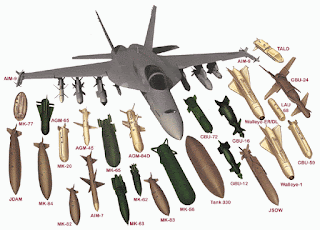
Harrington’s squadron would take their surveillance very seriously until they selected a few strategic targets to eliminate. The Hornet’s diverse array of weapons was staggering; WSOs would meticulously apply just the right firepower to match ancillary targets such as a road, a bridge, tracks, trucks, or antennae. The objective was to slow down any function supporting the Fordo site; and get all aircraft safely back to the ship.
 Part 4 in a series of fiction ripped from the headlines:

©Mark H. Pillsbury


