Showing posts with label earthquake. Show all posts

Sunday, March 22, 2020

Hegel and the US Constitutional System, 200-years later


Hegel's Philosophy of Government and History (1822)

[Problem -- Reaction -- Solution]


See the source image(quote) "if a people [Deu = volk] can no longer accept as implicitly true what its constitution expresses to it as the truth, if its consciousness or Notion and its actuality are not at one -- then the people's spirit may be torn asunder. 

Two things may then occur:


·         First, the people may either, by a supreme internal effort, dash into fragments this law, which still claims authority, or it may more quietly and slowly effect changes on the yet operative law; which is, however, no longer true morality, but which the mind has already passed beyond. 


·         Secondly, a people's intelligence and strength may not suffice for this, and it may hold to the lower law; or it may happen that another nation has reached its higher constitution, thereby rising in the scale, and the first gives up its nationality and becomes subject to the other nation.


Therefore, it is of essential importance to know what the true constitution is; for what is in opposition to it has no stability, no truth, and passes away. It has a temporary existence but cannot hold its ground; it has been accepted but cannot secure permanent acceptance; that it must be cast aside, lies in the very nature of the constitution. [Hegel adds: "This insight can be reached through Philosophy alone."]


Revolutions take place in a state without the slightest violence, when the insight becomes universal; institutions, somehow or other, crumble and disappear, as each man agrees to give up his rights.


A government must recognize that the time for this has come; however, should it, to the contrary, knowing not the truth, cling to temporary institutions, taking what — though recognized — is inessential, as a bulwark guarding it from the essential (and the essential is what is contained in the Idea), that government will fall, along with its institutions, before the force of mind.


The breaking up of its government breaks up the nation itself; a new government arises, — or it may be that the government and the inessential retain the upper hand." (end quote)


G. W. F. Hegel (Germany, 1820s)


_________________________________________________________________________


In this year, 2020, immersed in the current crisis, there exists the perfect inflection point for our government to go through a "Hegelian" type, internal, philosophical, political, constitutional inventory: Problem - Reaction - Solution. Which way will it go? Are these questions rational or logical? How does the Hegelian paradigm work?

Deep concerns surfaced when I read Hegel and a few others, wondering about survival: will the intelligence and strength of our citizens be sufficient to seek and find their true course, will it become subject to another nation, or could it fall apart in order to make way for a new set of "essential institutions" which rise up and become a new kind of American government?

We all have a lot of time to think about these essential questions right now...

Massive change occurs naturally during holistic, governmental crisis, on the scale we're experiencing in the first half of 2020. Like an earthquake, the global pandemic and economic crisis opened a fracture in the earth and the ground shakes with panic. 

This is a philosophical discussion, not just economic speculation, and I'm not making any predictions. The fire is fed by fear, anxiety, and it's ignited by the various media sources fanning the flames. Our culture is not as resilient as the generation forced to fight WWII, and this uncertain interim period lacks the same moral debate of war, because of the mysterious, nebulous, viral enemy. I'm not an economist, nor an epidemiologist, and I realize that this is a complicated scenario; however this is not the rambling of a doomsayer.

Some in the US government are considering huge legislative changes, accompanying large infusions of cash into a broken economy. Chaos in a democracy always allows change-agents, and politicians the opportunity to shoehorn, or tack-on significant deviations from societal norms, while tinkering with the macro-economic challenges of an emergency. We've heard a lot of this already from Democratic candidates for President during the 2019-2020 election cycle. 

Congress is negotiating a gigantic fiscal stimulus package on Sunday, March 22, 2020, with sprawling legislation and billions of dollars of support; but what will be embedded inside the bill, and will this be the only one?

If the crisis extends 18-months or more, with total economic meltdown, it reaches into a zone in which capitalism is not designed to work. If government changes course, to a more liberal, socialist, strongly-regulated environment or direction, there are numerous areas where simple changes in the federal laws would bring about generational shifts.

If I were writing on a whiteboard, these would be the areas that come to mind:


  • streamlined voting procedures (online and motor-voter laws)
  • lessened immigration controls
  • tightened gun-control
  • internet free speech limited by federal agency
  • universal basic income (cash for all)
  • expanded welfare state to combat income inequality
  • free, or pass/fail online university degrees
  • government controlled healthcare (single-payor)
  • elimination of electoral college
  • criminal justice and "Bail" reform
  • green "New Deal" legislation
  • significant carbon taxes on fossil fuels
  • restriction on oil & gas exploration & production in US
  • legalization of many kinds of controlled substances
  • de-militarization of federal government
  • revised federal sentencing guidelines
  • activist federal judiciary (changes in Article III)
  • foreign policy/shifting alliances
  • increased corporate responsibility via federal taxation
  • 21st Century Bill of Rights very different than current one

These are just a few areas (not in any order) where a new government, elected for 2021, enacting numerous changes during a continued societal and economic crisis, spurred on by pandemic and economic collapse, could take advantage of an inflection point or a fork-in-the-road for the American Republic, forcing it to go in a very different direction.

I'm sure there are areas I've not mentioned, or cannot conceive; I'm not a federal expert, and merely an amateur philosopher. Also, this is not all-or-nothing, binary thinking; just a few of the zig-zags listed above could radically change specific sectors. Nevertheless, I'm reminded that the word "decision" comes from the Latin word dēcīdere literally, to cut-off; which tells me that these important decisions can have far-reaching consequences.

In a formal discussion of Hegel's "dialectal" pattern, one might argue even, that current problems facing the US government, give it a unique opportunity to exploit calamity, in order to offer solutions planned long before the current environment, wherein the people react by asking for government help, while giving up certain rights previously held? [Problem - Reaction - Solution - all a part of the plan?]

On the other hand, if Trump is re-elected, and the health contagion were to passover, these essential, "revolutionary" changes would likely not rise up and dominate. The government would stay on the course, probably, as it was from 2017-2020 in Trump's first term. Deep thoughts, as I contemplate which way it will go and what legislative changes could mean?

Predictably, a second term for the 45th President would surely tamp down these potential changes for another decade; retaining the same values that give current institutions the upper hand. The subsequent seven-months will tell how the next generation will run its government; it is a moment of truth which caused me to want to write, and hopefully discuss. At this unique time in history, Hegel came along to prompt the paradigm. Thanks George.  ##


©NoelleBuske (photograph)
©MarkPillsbury (opinions)


Saturday, May 9, 2015

Fiction about The Fall: Ripped from the Headlines, 7.9 Kathmandu Super Earthquake

“I came to a place where every light is muted, which bellows like the sea beneath a tempest. The hellish hurricane, which never rests, drives on the spirits with its violence: wheeling and pounding, it harasses them. When they come up against the ruined slope, there are cries and wailing and lament, and there they curse the forces of the divine.” Inferno, Canto V (Dante)
(Nepal, April 28)
In Kathmandu you hold your breath when the mountain shakes.
 
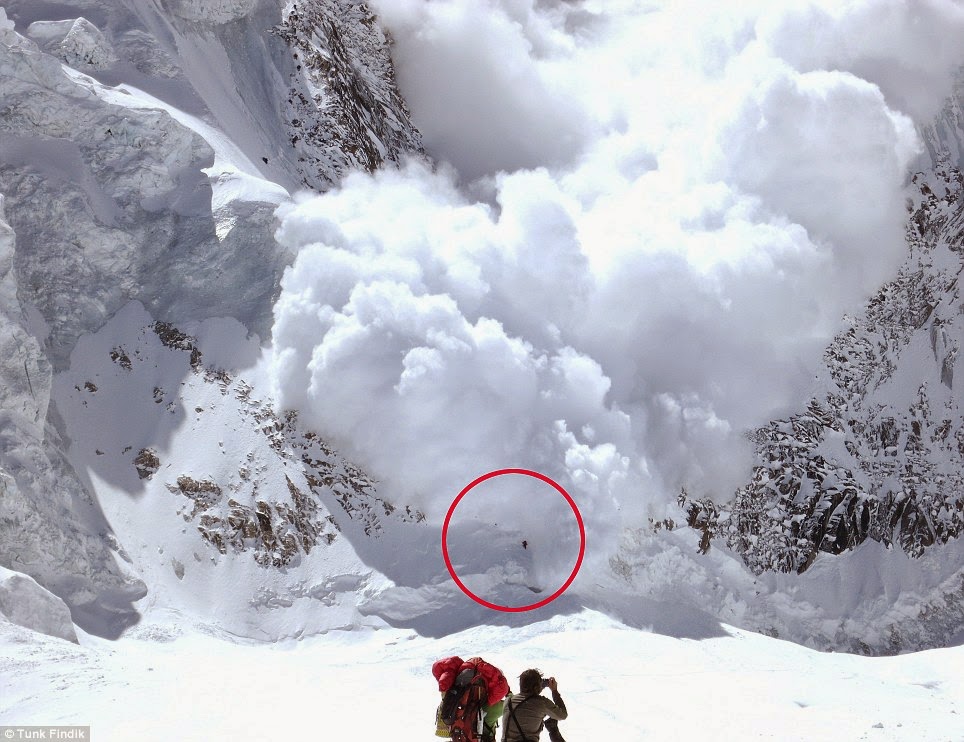
We were rolled up tight as a cocoon; staying warm, huddled in a group on the side of Everest; where the temperature never exceeds zero centigrade.

Photo from AP

The weather was calm in the early dawn; yet my tent was still slightly visible, colored brightly orange like a road cone. Ready for the next stage of climbing, maybe one more full day; the caravan zig-zagged, reaching for the top of the world’s most prestigious mountain, but staging this evening just below the summit at a camp called, “Khumbu Icefall.”

This expedition was made of a diverse band of new and experienced climbers, and numerous, ever-present Nepalese Sherpas: part pack-mule, part ghostly guide, slowly leading us by taking the burden and responsibility of “feeling” the mountain. Only those with an indigenous attachment to Everest had the sensitivity to divine what the sounds, smells, shadows, and winds spoke to those daring enough to confront its harsh conditions. Costing over $30,000 to join an expedition, one of the more unusual reasons to climb was attending the wedding of Nepalese couple Moni Mule Pati and Pem Dorjeee, Sherpas on the mountain in 2004.

Copyright of Berta Tilmantaite (2015)

Everest is not the world’s tallest mountain but that’s like saying the Kentucky Derby isn’t the world’s only horse race. Those who argue that it is the highest mountain in the world put its height at 29,035 feet, about the altitude of a cruising commercial jet. The ultimate prize of every climber, it's as if reaching the summit allowed you to wear a coveted green jacket. Sticking out of the Himalayas, stretching 1,500 miles along the border of Nepal and China; in 2014, an avalanche killed 16 guides, so far, the greatest tragedy ever seen on Everest. Hundreds sleep on the mountain forever, their frozen graves permanently affixed to the mountainside; however, since 1953, more than 2,000 people have successfully climbed to the peak.

If the earth suddenly rips apart by 3 feet, how does it make a sound as if an old man belched?

The sudden jarring shift ripped away the tent from its anchor spikes, earth turning to jelly; but it was the high, rumbling roar, the sound of fury and death raining down from above, which was horrific. The shaking quickly subsided even though the actual earthquake lasted more than 90 seconds. The oncoming thunder of the falling snow resounded with intensity for a short time; before it hollered down from a rolling wave like a hundred thousand head of cattle driving across the dry plains of Texas.


Whether rolling or falling, the descent depressurized and disoriented the climbers, the floor dropping from under them in an instant. Plummeting over 1,000 feet in 5 seconds, confined in millions of tons of hard packed snow; the most immediate threats were suffocation, wounds, and hypothermia. Tumbling over and over in a clothes-dryer motion; the chances that any of them would survive the somersaulting plunge were as unknown as a bouncing lottery ball.
 
The terror stopped like a pause button. After minutes that seemed like an eternity; the booming, roaring, violent cacophony of the Fall ended with a soft thud. I was like a hot-dog stuffed inside a moist, pallid bun. During the twisted, rambling, hellish descent down the mountain, in what could have been a meat-grinder; my limber body was intact. I laid wrapped in nylon and snow, still in silence, making inventory of my limbs with my nerve endings; waiting for the scream of pain, as the score.


I’ve felt alone before. The everyday worker, husband, student, or octogenarian can understand that sometimes the overwhelming isolation of the human condition causes one to feel shut-in, forced into confinement even if it is not physical restraint. The vacuum quiet of mind-numbing pain, the racing heartbeat of anxiety, fear, and dread, swallowed him whole; it reminded him of old school days, when the heat rash of embarrassment flushed through his skin: “Proceed to the Principal’s office young man; and do it now!”

“Sir, you need to turn around and put your hands behind your back…” If you can relate to that sort of disorienting confusion, if you’ve ever felt so deserted, distressed, and shocked that you wanted to close your eyes and wish it all away; then you can understand a little of what it was like to settle into a hole, interned at the bottom of an Avalanche. What is going to happen next; will I live or die?

#Fiction ©(2015)Mark H. Pillsbury


As you consider Nepal, please consider supporting these relief agencies as they strive to help the real victims of this earthquake still suffering:

UNICEF  The U.N. children’s agency, UNICEF, says nearly 1 million children in Nepal need help. UNICEF says it is preparing two cargo flights with a combined 120 tons of humanitarian supplies including medical and hospital supplies, tents and blankets, for urgent airlift to Kathmandu.
Online: http://www.supportunicef.org

World Food Program
The U.N. World Food Program says logistics and emergency response teams have arrived in Kathmandu.
Online: https://give.wfp.org

Red Cross
The International Committee for the Red Cross says it is working with the Nepal Red Cross Society and has a team working on emergency response.
Online: http://familylinks.icrc.org

Save the Children
Save the Children says it has staff in 63 districts and emergency kits, hygiene materials and tarpaulins already in Nepal and ready for distribution. Additional supplies and emergency recovery teams are being flown in.
Online: https://secure.savethechildren.org

Oxfam
Oxfam says its team in Nepal is assessing needs and it is sending emergency food, water and sanitation supplies. “Communication is currently very difficult. Telephone lines are down and the electricity has been cut off making charging mobile phones difficult. The water is also cut off,” country director Cecilia Keizer says in a statement.
Online: https://secure2.oxfamamerica.org

Doctors Without Borders
Doctors Without Borders, also known as Medecins Sans Frontieres, says it is sending medical staff and supplies to Nepal, including emergency surgical teams.
Online: https://donate.doctorswithoutborders.org

Samaritan's Purse
The Christian aid organization has deployed a disaster relief team and initial supplies for 15,000 households to support partner hospitals.
Online: http://www.samaritanspurse.org

Friday, May 1, 2015

Poetry: Pray for Nepal

Swirling, smoking plumes rise heavenward:  thousands of billowing pyres burn with bodies and straw;

People crushed, both alive and dead, carry on a tradition all over Nepal.

By the will of the gods, dark turmeric smoke is life’s breath to the wind,

As is its nature, the body returns to the sky, a gift that its family sends.

The heaving ground broke open their souls, leaving gaping holes deep and black,

Unnerved, unprepared, enveloped by chaos; this poor country was caught by surprise attack.

As history flows from the Bagmati into the Ganges; Nepal’s tragedy washes into Bengal’s yellow bay; life’s shraddha (inheritance) is more than what is evident today.

Blessed are the meek, the survivors of this disaster; their only hope is that relief arrives faster.

How can they inherit an earth that so quickly and violently destroyed their nation?

My thoughts put to poetry don’t help the situation; but what can I do for Kathmandu?

All I can do is #pray4Nepal

©Mark H. Pillsbury (Houston)

["A poem... begins as a lump in the throat, a sense of wrong, a homesickness, a lovesickness. It is a reaching-out toward expression; an effort to find fulfillment. A complete poem is one where an emotion finds the thought and the thought finds the words..." (Robert Frost, 1916)]