Showing posts with label politics. Show all posts

Friday, December 31, 2021

Michael Berry: The Czar of Talk Radio

 The Czar of Talk Radio

[*Author’s note:  as he wrapped up the past year sitting in the EIB chair, talking into the golden microphone that Clay Travis and Buck Sexton inherited from the great Rush Limbaugh, Houston radio personality Michael Berry was introduced to the largest talk-radio audience in the country, acting as the "substitute-teacher" guest-host for two dudes who are trying to fill the biggest shoes of the medium, upon Rush’s death earlier in 2021. This is a profile of Michael Berry for any loyal Rush listener tuning-in this past week, wondering who he was? I’ve been listening to him long enough, he seems like a brother to me, so here I go… all mistakes in fact and wild opinions are mine, Mr. Berry would not invite me to come to their new studio and had no comments for my article; any quotes are from on-air material.]

Sunday, March 22, 2020

Hegel and the US Constitutional System, 200-years later


Hegel's Philosophy of Government and History (1822)

[Problem -- Reaction -- Solution]


See the source image(quote) "if a people [Deu = volk] can no longer accept as implicitly true what its constitution expresses to it as the truth, if its consciousness or Notion and its actuality are not at one -- then the people's spirit may be torn asunder. 

Two things may then occur:


·         First, the people may either, by a supreme internal effort, dash into fragments this law, which still claims authority, or it may more quietly and slowly effect changes on the yet operative law; which is, however, no longer true morality, but which the mind has already passed beyond. 


·         Secondly, a people's intelligence and strength may not suffice for this, and it may hold to the lower law; or it may happen that another nation has reached its higher constitution, thereby rising in the scale, and the first gives up its nationality and becomes subject to the other nation.


Therefore, it is of essential importance to know what the true constitution is; for what is in opposition to it has no stability, no truth, and passes away. It has a temporary existence but cannot hold its ground; it has been accepted but cannot secure permanent acceptance; that it must be cast aside, lies in the very nature of the constitution. [Hegel adds: "This insight can be reached through Philosophy alone."]


Revolutions take place in a state without the slightest violence, when the insight becomes universal; institutions, somehow or other, crumble and disappear, as each man agrees to give up his rights.


A government must recognize that the time for this has come; however, should it, to the contrary, knowing not the truth, cling to temporary institutions, taking what — though recognized — is inessential, as a bulwark guarding it from the essential (and the essential is what is contained in the Idea), that government will fall, along with its institutions, before the force of mind.


The breaking up of its government breaks up the nation itself; a new government arises, — or it may be that the government and the inessential retain the upper hand." (end quote)


G. W. F. Hegel (Germany, 1820s)


_________________________________________________________________________


In this year, 2020, immersed in the current crisis, there exists the perfect inflection point for our government to go through a "Hegelian" type, internal, philosophical, political, constitutional inventory: Problem - Reaction - Solution. Which way will it go? Are these questions rational or logical? How does the Hegelian paradigm work?

Deep concerns surfaced when I read Hegel and a few others, wondering about survival: will the intelligence and strength of our citizens be sufficient to seek and find their true course, will it become subject to another nation, or could it fall apart in order to make way for a new set of "essential institutions" which rise up and become a new kind of American government?

We all have a lot of time to think about these essential questions right now...

Massive change occurs naturally during holistic, governmental crisis, on the scale we're experiencing in the first half of 2020. Like an earthquake, the global pandemic and economic crisis opened a fracture in the earth and the ground shakes with panic. 

This is a philosophical discussion, not just economic speculation, and I'm not making any predictions. The fire is fed by fear, anxiety, and it's ignited by the various media sources fanning the flames. Our culture is not as resilient as the generation forced to fight WWII, and this uncertain interim period lacks the same moral debate of war, because of the mysterious, nebulous, viral enemy. I'm not an economist, nor an epidemiologist, and I realize that this is a complicated scenario; however this is not the rambling of a doomsayer.

Some in the US government are considering huge legislative changes, accompanying large infusions of cash into a broken economy. Chaos in a democracy always allows change-agents, and politicians the opportunity to shoehorn, or tack-on significant deviations from societal norms, while tinkering with the macro-economic challenges of an emergency. We've heard a lot of this already from Democratic candidates for President during the 2019-2020 election cycle. 

Congress is negotiating a gigantic fiscal stimulus package on Sunday, March 22, 2020, with sprawling legislation and billions of dollars of support; but what will be embedded inside the bill, and will this be the only one?

If the crisis extends 18-months or more, with total economic meltdown, it reaches into a zone in which capitalism is not designed to work. If government changes course, to a more liberal, socialist, strongly-regulated environment or direction, there are numerous areas where simple changes in the federal laws would bring about generational shifts.

If I were writing on a whiteboard, these would be the areas that come to mind:


  • streamlined voting procedures (online and motor-voter laws)
  • lessened immigration controls
  • tightened gun-control
  • internet free speech limited by federal agency
  • universal basic income (cash for all)
  • expanded welfare state to combat income inequality
  • free, or pass/fail online university degrees
  • government controlled healthcare (single-payor)
  • elimination of electoral college
  • criminal justice and "Bail" reform
  • green "New Deal" legislation
  • significant carbon taxes on fossil fuels
  • restriction on oil & gas exploration & production in US
  • legalization of many kinds of controlled substances
  • de-militarization of federal government
  • revised federal sentencing guidelines
  • activist federal judiciary (changes in Article III)
  • foreign policy/shifting alliances
  • increased corporate responsibility via federal taxation
  • 21st Century Bill of Rights very different than current one

These are just a few areas (not in any order) where a new government, elected for 2021, enacting numerous changes during a continued societal and economic crisis, spurred on by pandemic and economic collapse, could take advantage of an inflection point or a fork-in-the-road for the American Republic, forcing it to go in a very different direction.

I'm sure there are areas I've not mentioned, or cannot conceive; I'm not a federal expert, and merely an amateur philosopher. Also, this is not all-or-nothing, binary thinking; just a few of the zig-zags listed above could radically change specific sectors. Nevertheless, I'm reminded that the word "decision" comes from the Latin word dēcīdere literally, to cut-off; which tells me that these important decisions can have far-reaching consequences.

In a formal discussion of Hegel's "dialectal" pattern, one might argue even, that current problems facing the US government, give it a unique opportunity to exploit calamity, in order to offer solutions planned long before the current environment, wherein the people react by asking for government help, while giving up certain rights previously held? [Problem - Reaction - Solution - all a part of the plan?]

On the other hand, if Trump is re-elected, and the health contagion were to passover, these essential, "revolutionary" changes would likely not rise up and dominate. The government would stay on the course, probably, as it was from 2017-2020 in Trump's first term. Deep thoughts, as I contemplate which way it will go and what legislative changes could mean?

Predictably, a second term for the 45th President would surely tamp down these potential changes for another decade; retaining the same values that give current institutions the upper hand. The subsequent seven-months will tell how the next generation will run its government; it is a moment of truth which caused me to want to write, and hopefully discuss. At this unique time in history, Hegel came along to prompt the paradigm. Thanks George.  ##


©NoelleBuske (photograph)
©MarkPillsbury (opinions)


Sunday, March 23, 2014

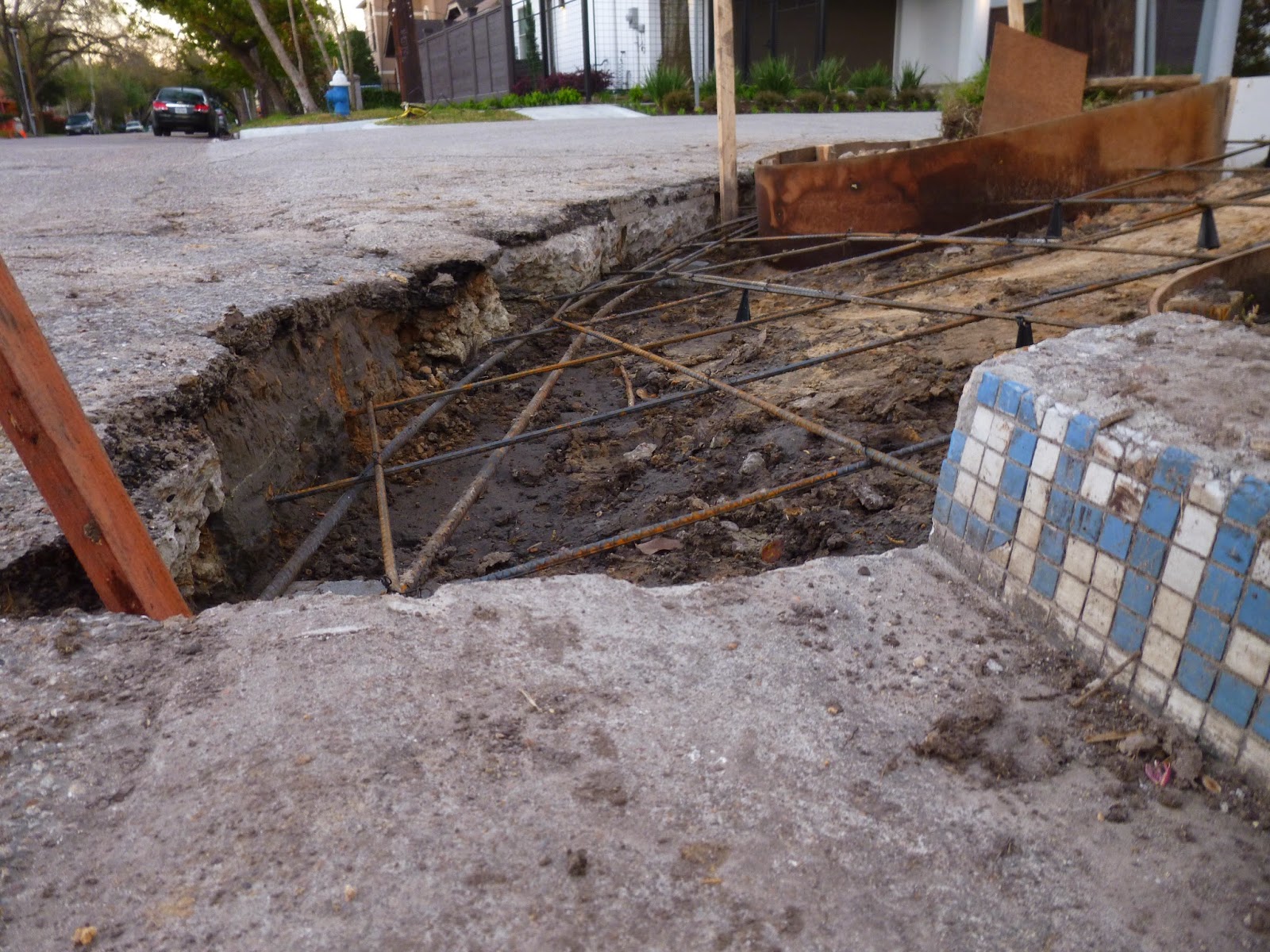
Taking Potshots at Potholes

Taking Potshots at Potholes:
Public Stewardship & Public Enemy #1
An immediate gratification, “rock-star” culture says, “you can have it all;” so why can’t the City of Houston have sexy parks, bridges, trails, foliage, bayou views, separate paths for bikers and runners; as well as smooth streets without potholes?
 

Citizen drivers weave around on decaying streets, further burdening them as they try to live their stressful lives. A smooth ride is interrupted by a sudden jolt, unexpected and jarring. Pressure builds, heightened by the inconvenience and pain of traffic in Houston: too many people going in the same direction at the same time. I believe that minimally, our government owes us good roads, just as it says it owes its citizens equal justice under law. Don't you agree?
As my car’s under-carriage rattles over concrete crevasses, dodging massive cracks in our pavement the size of the San Andreas Fault; there’s no avoiding the havoc wreaked by this civic catastrophe. If you’ve ever survived the gauntlet of Houston’s potholes in almost any neighborhood, look at the vehicle in front of you as the road tries to eat it alive; most of our automobiles weren’t made for this kind of abuse. Watch the violent shaking and jostling  of the car’s suspension in front of you; if you see natural mechanical reactions then let me know: it looks horrible to me.
Blogging about this problem is my humble attempt to echo satirist Paddy Chayefsky’s famous line spoken by the outrageous Howard Beale in Network (1976). Don't view my effort as caricature; indeed, my hopes are that at least one local elected official, even the Honorable Mayor, would read this and know that there are thousands of honest, taxpaying citizens of this city that are thinking the same irate thoughts but don’t have the time, voice, or platform to yell out from their car windows:
"I'm as mad as hell, and I'm not going to take this anymore!"
(MGM, 1976)
Buffalo Bayou Park stretches over 10 miles from Shepherd to the central business district with a wide variety of public recreational areas on both sides of the bayou. Multiple years and millions have produced a gem for all Houstonians. I’m not anti-park or anti-public recreation; this new area along the bayou is Houston’s answer to Central Park. Having exercised in this area, it's clear it is a wonderful addition to our public life; however, I also drive hundreds of miles all over Houston’s lousy streets, bouncing from one canyon to another in the regular roadways of our city. To which person do we cater? The commuter or the tri-athlete; the delivery truck or the strolling mommy? If the solution is not unlimited taxation; civic priorities must constantly be weighed like a personal budget: wants versus needs?
 
Buffalo Bayou Park Under Construction
I’m not complaining that there are as many construction cranes and concrete trucks barreling along Houston’s roads as any city in the country. There is inconvenience in “progress;” just as the drought and roots of our massive live oaks buckle the ground underneath the road beds.
 

This blog-post is heavy on advocacy and light on blame; potholes surpassed mosquitoes as public enemy #1 in the bayou city—the solution is not complicated: spray for pests and patch the holes in every neighborhood. If NASA can put spaceships into orbit, our elected representatives can fix the plague of potholes. One district, one street at a time!
 
This chastisement of public stewardship finds root in the recent wasting of city funds on non-performing investments like red-light cameras (Civil settlement, $12MM), or Astrodome maintenance ($1MM/annually). One repaired hole costs $20, so I'd trade a dark Astrodome for 50,000 less potholes, wouldn't you? And this pothole-burden isn’t an isolated situation; there are other city's municipal budgets shrouded in debt, or floundering in mismanagement whose streets engulf drivers too. On the other hand, this city is booming; there’s no reason all our gasoline taxes can’t fix the crumbling roads. It's a management problem Houston; but where is the political will to fix it? Is anyone listening?
 
(Ever heard the joke; Q: How many City of Houston workers does it take to fill a pothole? A: 9!)
 
Government at the local level is about as basic as it gets in politics! This isn’t about Super-PACs, Hilary Rodham-Clinton, or Meet the Press. CNBC’s Rev. Al Sharpton won’t stoop so low as to talk about potholes, because they don’t involve race. Nevertheless, this political message carries immediate impact: the same way my car shakes with a boom; unexpectedly careening over a gaping chasm of concrete. If Houston is a first-class, global city; it should act like it.
Mayors famously lose their elected offices for not clearing snow or rescuing stranded citizens in a hurricane? The key component of a city government is their Budget: it’s the city’s business plan. Whether to spend important budget dollars on one project over another (especially when they're both good) provides circumstances in city government critical to quality of life in the town. Even in a city as large as Houston, tough choices can cost elected officials their jobs. Now is this sort of time. I’m urging our city government to drive around the streets and realize the embarrassing condition of the roads: pocked and pitted, gaping gashes, ribbons running like giant fissures; streets grey and cratered like the Moon's surface. While running along our largest bayou is a newly constructed, pristine fitness path:
Trail under the Waugh Bridge
Unlike Howard Beale, I’m not trying to get you to do anything. No class-action lawsuit, no riots, don’t call your favorite talk show on AM Radio, don’t even write your Congressman. I wouldn’t know what to say to a Congressman anyway. They answer your letters with canned forms, computer-generated rhetoric, anyway?! If you feel led; communicate however you feel comfortable. If you hear me, forward someone a link to my blog. I’m speaking for you right now by saying, "I'm mad as hell about these terrible Houston roads ruining my nice car!” 
Scenes from the Pothole Playhouse: 
(Screaming)
(Citizen): “I'm not going to take this horse-pookey anymore; our city has enough money to fix the potholes; if it would just use the political capital to do so;” he adds, "I'll be the chairman of the Pothole Task Force."


(Pointing accusingly)
(Second citizen): “For once, do something practical with our money; not just what gets the fancy attention, like a pretty new Park!” “Jeez, dude. Do your job, or let someone else try…” "It's not that darn complicated."
 
 Op-ed©2014—Mark H. Pillsbury (Houston, Texas)

Follow more on Twitter® (@markpills) 

[Serious Legal Disclaimer:  thoughts expressed here are my own, and do not represent the political opinions of any group, organization, or corporation with which I associate. The first amendment and the rules of the blogosphere protect all the free speech exercised herein. This doesn't represent a political cause or party, nor does it endorse a particular candidate. If an elected official feels offense or shame over the subject matter of this post, their response is out of my control, and they need to take a long look in the mirror.]

All pictures are ©2014—Mark H. Pillsbury (Houston, Texas) #nofilter
 
-30-


Saturday, February 2, 2013

Movie Review: LINCOLN


DreamWorks film "Lincoln" (2012)

(Houston, Texas)  Movies allow us time travel, expanding our horizons, opening us sometimes to depths of emotion we did not realize we carried. History’s power as storyteller derives from actual events; yet knowing the end of the story, the dramatic depiction still holds our attention. It happened to me watching the new movie “Lincoln.” I wasn't impatient for the end of the movie, and hardly noticed its extreme length. I rarely recommend the time and money this film requires of its viewers, but I do today.

The adept telling of history strengthens the foundation of our Republic, grounding it ever stronger in the truth; allowing viewers to probe their ordinary world with the tools of experience. Director Steven Spielberg accomplishes the impossible task of telling Lincoln’s story with aplomb, placing special emphasis on the passing of the 13th Amendment by Congress in 1865. This central narrative showed how the abolition of slavery effected the drive toward peace in the Civil War.

Euclid’s simple scientific truth profoundly affected Lincoln’s thinking about human equality. Elemental to the geometry of Euclid was this statement, “things which are equal to the same thing are equal to each other.” Abraham Lincoln likened this principle as truth that could be applied to the fight against slavery: he saw the “same thing” as God; therefore, as equals created in God’s image, African slaves were equal to white Americans, however difficult the consequence of this truth. This is the only scene I will discuss, and even though it is short, its power is immense: Lincoln steadfastly believed equality under law was worth defending, even through the shedding of blood.  

The acting ensemble, including dozens of politicians, generals, and White House personnel, gave the appearance of reality while not taking the spotlight from the main character. Spielberg’s use of light in profile shots formed a corona from the differentiated rays of the sun blasting around Lincoln’s body in many scenes. This bright aura reflects his uncommon magnanimity; another way of visually showing the saintly reverence Lincoln deserves. Most of what we've learned about history is wrong, but this movie gives a fair account. The South is not demonized, the Congress is shown for what it is (a hyper-lobbied mess), Lincoln struggled with a difficult family life as the war raged, and the force of personality often superseded his political and intellectual talent.

The pantheon of Spielberg classics receives another member into its prestigious Hall of Fame. This movie is a national treasure and should not be missed. (150 minutes, DreamWorks)

©Mark H. Pillsbury

Friday, September 7, 2012

God Gets The Last Word: Cardinal Dolan's Pro-Life Benediction at #DNC2012

God Gets The Last Word: Cardinal's Pro-Life Benediction:

'via Blog this'


The current Archbishop of New York, Cardinal Timothy Dolan's sobering closing prayer at the Democratic National Convention last night reminded me of a classic scene, wherein parents come home from vacation a day earlier than planned on a late evening flight. 

At 2AM they pull into their driveway clueless, next finding 25 drunken teenagers spread across the living room in various states of consciousness and dress. The only thing anyone can say is nothing, as everyone bolts for the exits!

Watching these sleepy delegates' reactions to the benediction is priceless. My total respect for the Cardinal is unbounded as he speaks unflinching truth and humble prayers to God, of which they earlier tried to exclude from the platform. I could only feel astonishment that after 4 days of political platitudes; finally, someone spoke the truth to these poor folks. This clip is worth your time. [see link posted above; play time > 5 min.]

©Mark H. Pillsbury

Sunday, July 15, 2012

Dinesh D'Souza - CPAC 2012 speech - It launched a Movie: 2016

Dinesh D'Souza - CPAC 2012 speech - YouTube: "http://youtu.be/Z6QOscKvUjU"

'via Blog this'

This Speech has been made into a Movie, by Dinesh D'Souza (YouTube video above)

Why wouldn’t this country’s media dig deeply into a relatively unknown candidate? Why did the pleasure of overcoming an historical barrier override the typical journalistic effort applied to a major candidate?

Did they review carefully the life of Barack Obama as they did candidates like George W. Bush or John Kerry?

Who were the most influential people in the life of Barack Obama, considering he never knew his father? So many facts about Barack Obama are left unexplained.

How does Obama’s history of leftist, radical, socialist/anti-colonial politics match with the accommodating image of a moderate, post-partisan candidate portrayed in the 2008 campaign? What happens after Obama does not have to campaign anymore? The movie suggests what the country will look like in 2016.

Why did Bill Ayers, Frank Marshall Davis, Jeremiah Wright, and so many of Obama's mentors get pushed aside during the campaign? If the American people knew who Obama was they would see he is not an ordinary Democrat. He's not just a Chicago-style influence peddler/community organizer, he has a global vision unlike any other president in our history.
Frank Marshall Davis

I came to these conclusions about the next term of an Obama presidency:
  1. What can relieve some of the pressure on the government to bring in more revenue? More taxes. The CBO estimates the new tax burden will be 3% of GDP.
  2. Has the power and prestige of US foreign policy increased or decreased during this presidency? It has been a twisted and confusing foreign policy and ultimately islamic power in the middle east has risen and our standing and the standing of Israel has decreased. (Iran, Libya, Syria, Egypt... do they seem consistent?)
  3. The movie sets forth a dichotomy between two worldviews that anyone watching the movie has to decide between?  Oil drilling, NASA, radical Islam issues: Libya versus Syria, Iran versus Egypt, bigger government, healthcare, re-aligning American foreign policy away from Israel, there are so many parts of the Obama story that puzzle me.
  4. Even if one supports Obama, but has not read his books, it is worth to see how the scholar and political writer Dinesh D'Souza peels back Obama's own words in the books that many of us did not actually read?! Even if you think you know a lot about the president, there is stuff in here which is surprising, and it comes right out of Obama's mouth.
  5. Much of the movie is taken with drilling into the words of Obama's story as previously written, and interdicting the his story with more factual research. This is the kind of work that America's media aristocracy chose not to do. For some reason he just got a pass. Maybe that will not continue in a second Obama term.
I learned many things from this work and highly recommend that anyone interested in politics, history, presidential power, or current events, take time to go see this movie as it tries to interpret what Obama will do with a second term. It opens all over the country on July 27, 2012.

©Mark H. Pillsbury

Wednesday, January 4, 2012

Justice: why don't we talk about justice in church?

Why don’t we talk about justice in church?
Gary A. Haugen, Attorney, and president/founder of International Justice Mission, suggests (3) three reasons why the church is reluctant to preach justice:
  
1.   Pastors are reluctant to preach justice because it’s perceived to bring politics into the pulpit. Partisan politics has no place in the pulpit.

The central focus of preaching should be the gospel not the voting booth. There are many churches that get involved with electoral politics, pursuing candidates from their neighborhood to make changes in oppressive, unjust political systems. However, the purpose of a sermon is to exposit the biblical truth of Jesus and his resurrection, not that Justice and Jesus are exclusive of each other. It takes a pastor who can weave into biblical exegesis Jesus’ desire that humans would be free from the guilt, sadness, anger, confusion, and harm resulting from their sin; instead turning from things like injustice and following him to the cross. 

Jesus had to take for form of a sacrificial lamb in order for true justice to be wrought on humanity through him. Jesus embodies justice and mercy together; his blood paid the ransom for our sin, and makes peace with everyone possible, including God. This amazing mercy was the antithesis to justice although it does not lessen the severity of the justice required to conquer sin. Pastors who talk about social justice in the present day sometimes miss this point about biblical justice in the person of Jesus Christ. The trouble with bringing politics into a sermon is that Christians of both political parties are trying to do the right thing. Maybe the first thing we should do with any candidate is ask them to define their vision of “justice,” and to see that they act wisely in practical matters.

2.   Justice is not always connected to the felt needs of those in the pew. For largely middle-class congregations of North America, injustice is a subject read about in the news, not lived daily.

Big churches like one I can think of in Houston, deal with self-improvement from the pulpit as much as they do anything like “justice.” The pastor I’m thinking of acts as encourager-in-chief not the head of missions. Focusing on the outside world takes commitment, organization, passionate volunteers, and a network of global organizations. Thinking about justice, and acting upon it even in the smallest neighborhood way is more gritty and granular than discussing self-worth, and positive mental attitude. Supporting just causes requires a level of interaction that some churches abhor. They would rather do things within their own congregation than actually have to fellowship with Christians or non-Christians that don’t believe how they do. It gets messy!

Comfortable, middle-class Americans don’t spend much time thinking about justice until it affects them! The idolatry of “comfort” is pervasive in the modern church, so this disconnect is not surprising. For the conversation to turn to justice, our hearts must change. Christians must be so struck with the injustice in their own hearts and what Jesus did to change them that they want to help those who are the victims of injustice, or to right those maladies in the world that are unjust. Progress will come from the inside out, beginning with an awareness of severe problems in the world on more than a conceptual level.

"Here is one choice that our Father wants us to understand as Christians – and I believe it is the choice of our age:  Do we want to be brave or safe? Gently, lovingly – our heavenly Father wants us to know that we simply can’t be both."  — Gary A. Haugen
  
3.   Talking about justice opens the door to despair in our world. The overwhelming quantity and depth of world problems leaves us feeling fatigue and/or paralyzed.

I tend to bounce off that perspective, not because it is incorrect but the larger view is that there is injustice because of the nature of the fall (Genesis). Even though I think Mr. Haugen is accurate, I would argue from a larger idea that injustice is rooted at the foundation of brokenness between each human and God. It is spiritual poverty that causes the relationships in our lives not to work. This is something the North American church is not comfortable admitting! One of the biggest problems in the promotion of justice is that the people who don’t think about justice are actually working through a God-complex. These poor souls are perfectly fine with the concept of justice as long as they are not mistreated themselves; and further that any contribution to injustice begins with looking outside their own hearts for the culprit.

Many Christians tend to think that justice is a problem for someone else, that alleviating injustice (or poverty for that matter) is not an exclusive task of the church. That begs the question, however; who will take up the cause? The government?

If God’s two greatest commandments are to love God with all our hearts, souls, and minds; in other words, our whole being. And secondly, we are to love our neighbor as ourselves (see, Matthew 23 for this restatement of Old Testament commandments). Surely the great commission flows out of this kind of revolutionary love: demonstrated through acts of kindness, compassion, and justice. The mission of God to love his people through us certainly requires that we seek justice in all facets of our life.

The spread of the kingdom of God is to be carried out on earth by His Church, as they have been commanded in the Bible. Through the power of the Holy Spirit within us, having sincere hearts dedicated to justice; Jesus’ followers are to take up the task. Even though it takes work, we are not to sit by idly and give up. The people of God are to reclaim and redeem the world for Christ. “As the Father has sent me, even so I am sending you.” (Jesus’ command in John 20:21)

©Mark H. Pillsbury

Saturday, December 17, 2011

Gingrich Is Inspiring—and Disturbing - WSJ.com

Gingrich Is Inspiring—and Disturbing - WSJ.com:

'via Blog this'

Penetrating, sobering, incisive, thoughtful, fascinating, creative, leading-edge, stimulating, charming, and talented political prose about the rise of GOP candidate Newt Gingrich by Wall Street Journal columnist Peggy Noonan.

She continually writes opinions that make me think long and hard about a topic. Thank you Peggy!

Tuesday, October 25, 2011

Rousseau and Obama

“Barack Obama presented himself early in the 2008 campaign as the man-of-the-earth candidate; the politician able and eager to speak to — and listen to — all sides.” –Bill Bishop in “The Big Sort,” (Houghton Mifflin Co. 2011). The American electorate had not fallen for a candidate as they did for Barack Obama, in a long time.


Benjamin Storey, assistant professor of political science at Furman University, wrote recently about the psychic phenomena of “admiration,” the capacity to be awed and moved by human beings we find impressive. Prof. Storey believes admiration is central to political life. Journal of Politics Vol. 73, No. 3 July 2011 Pp. 735-747. [This is an “academic” article but useful].

However, to Rousseau there was no such thing as a rational admiration:  “Society always romanticizes something, and idolaters of wealth, enlightenment, or power are no more immune to this passion than are the fanatical followers of prophets.”

Howard Univ. professor Brian Gilmore discussed Barack Obama as the new “American Rousseau” at Thurgood Marshall School of Law in 2009 in the first year of his presidency. Prof. Gilmore’s presentation was called American Rousseau: Barack Obama and the Social Contract. I attended this speech.

The Social Contract, is complex, yet systematic; outlining how a government exists in such a way that it protects the equality and character of its citizens, keeping in mind the balance between the supreme authority of the state and the rights of individual citizens. It is a social compact that protects society against factions and gross differences in wealth and privilege among its members. I will not try to delve deeply into that document, but Gilmore discussed it in the context of the Barack Obama movement of 2008.

With the election about a year away, these professors caused me to think about questions involving the President in light of the life and philosophy of Jean-Jacques Rousseau (1712-1778):

Q: Is Barack Obama the idol of a generation, a new American Rousseau?

Q:  Did the 2008 presidential election illustrate political “messianism” in the electorate?

[at this point, Rousseau would have us ask the question: In our social and political lives, it is not whether we have heroes, but what kind of heroes we have?]

Q:  What kind of hero is Barack Obama?

From reading about Rousseau, I think Barack Obama’s presidency was born out of a romantic nationalism in which the special appeal of charismatic leadership dominated over rational analysis. This can be called admiration over observation.

Republican democracy requires that people pay attention and participate in public affairs. The intention of this post about Barack Obama is to allege that the electorate was blinded by the celebrity and charisma of his candidacy, not willing to thoroughly analyze his prior experience and record. 

My thought is that “admiration” for Barack Obama as the first legitimate presidential candidate-of-color contributed greatly to campaign success. Additionally, the mantra of hope and change became almost messianic for those swept up in this movement.

Rousseau understood the power of admiration for good or for evil, in fact he paints the tension between the “natural and the civil state” as great, but also sad:

“Fanaticism, although sanguinary and cruel, is nevertheless a grand and strong passion which elevates the heart of man, makes him despise death, and gives him a prodigious energy that need only be better directed to produce the most sublime virtues.” Rousseau believed that power and strength are an essential quality of those who can arouse it in others.

As a romanticist, Rousseau’s influence was profound.

“In human terms [a Romantic] prefers the unique individual to the average person, the free creative genius to the prudent person of good sense, the particular community or nation to humanity at large. Mentally, the Romantics prefer feeling to thought, more specifically emotion to calculation; imagination to literal common sense, intuition to intellect.”(Quinton 1996). This definition reminds me of Barack Obama. 

In numerous areas (ex, Obamacare legislation, debt crisis), this president’s policies illustrate how a “romantic democracy” imbued with the ethos of power and strength, lacking transparency, can slowly evolve into a “totalitarian democracy” as the balance shifts toward the supreme authority of the state. The administration uses brute force, passive aggression, and even guilt to influence legislation, often imploring legislators to just “trust him,” and vote for a his version of a bill, despite timing or length of the legislation. I believe the president relies on the fact that because many “admire” him, few will oppose him.

Jean-Jacques Rousseau’s portrait hung above Karl Marx's writing desk, maybe because Rousseau said, “those not willing to free themselves from their attachments would be ‘forced to be free’.”

To answer some of the questions raised here, I would say that Barack Obama was given American Idol status without singing a note. The 2008 election was a short period of romantic democracy, even political messianism; Barack Obama was the kind of hero people were looking for: Democrat, desirable, dashing, different, diverse, detached, deft, dapper, defiant, dynamic, deep, and dedicated to hope and change. I am not sure if the love will last, however.

©Mark H. Pillsbury

Sunday, October 9, 2011

Herman Cain steps up attacks on Occupy Wall Street protests - latimes.com


quoted from the article: Nancy Pelosi and I agree on something:

Herman Cain steps up attacks on Occupy Wall Street protests - latimes.com: (Nancy Pelosi)"“I support the message to the establishment, whether it's Wall Street or the political establishment and the rest, that change has to happen,” she said “We cannot continue in a way that does not — that is not relevant to their lives. People are angry.”"

'via Blog this'

Hope and change must be relevant to the voter's life. 7 out of 10 Americans believe that the President has not handled the economy correctly and now Nancy Pelosi says that change "has to happen." I agree with her. The next general election is a great place to start.

Wednesday, September 7, 2011

True, This! — Beneath the rule of men entirely great,
The pen is mightier than the sword.
Behold, the arch-enchanters wand! — itself a nothing!
But taking sorcery from the master-hand
To paralyze the Cæsars, and to strike
The loud earth breathless! — Take away the sword —
States can be saved without it!

--Edward Bulwer-Lytton (1839) for his play about Cardinal Richelieu

Tuesday, June 21, 2011

Stimulus Package a/k/a TARP and "shovel-ready" jobs

I heard President Obama joke: "Shovel-ready was not as . . . uh . . . shovel-ready as we expected..." The problem with that is . . . uh . . . he wasn't very funny!

Why does the POTUS just get a pass on this type of behavior? When the previous president would have been eviscerated for such an insensitive joke/comment.

No sir, the whole "shovel-ready" scam did not even occur; not even sure that GAO could measure what it turned out to be, but jobs did not spontaneously arise out of the vaunted stimulus package.

Was it a way to appeal to the old FDR notion of the WPA work creation on public works and infrastructure projects that admittedly need some work? Even construction jobs are much too sophisticated to just hand some out-of-work-dude a shovel and solve the economy's problems. It was immature and naive to think "shovel-ready" was a viable alternative to the economic woes of the country at that time.

What we need now is not the absence of uncertainty, which is so often written about in the newspapars. The economy needs a rolling-back of much of the Obama legislation and the freeing up of small business to start hiring again. Small business is not "afraid" of uncertainty, in fact, on the contrary, they are afraid of what the anti-business administration has accomplished since 2009.

http://tiny.cc/78ae5 (article link)
By CLIFFORD S. ASNESS (Wall Street Journal)
Suggests that drag on the economy in such legislation as Dodd-Frank and ObamaCare, is what actually slowed down hiring, which is still our most pressing problem, and something that POTUS still is not acknowledging. The economic engine will not run smoothly without full employment. Could the POTUS acknowledge that Keynesian solutions have not worked in the market and work with Congress to throw off the fetters on small business? Either he will, or the voters will force the point.